Assuming EMI of an EUT exceeded limitation at specific frequency and the EUT failed to pass a laboratory test.
EMCExplorer-SAAS use the origin EUT as "Referenc EUT" and compare so called "improved EUT" with it to ensure the EMI is gradually reduced by modification.
Since the standard EMC test uses the power input of the EUT as the test point, we also choose to measure the voltage waveform of a signal with the power input of the EUT as the test point, and identify the signal as the "Reference Data".
In practice, try to keep the "Reference EUT" unchanged, and select a sample of same model with the same specification as "Improved EUT". If no extra EUT sample is available, the "Reference EUT" must be thoroughly tested and the test methods and detailed procedures need to be documented, then, the EUT can be used as an "Improved EUT".
If you need to do a quantitative analysis of the EMC status of the "Improved EUT", you can calibrate the "Reference Data" by:
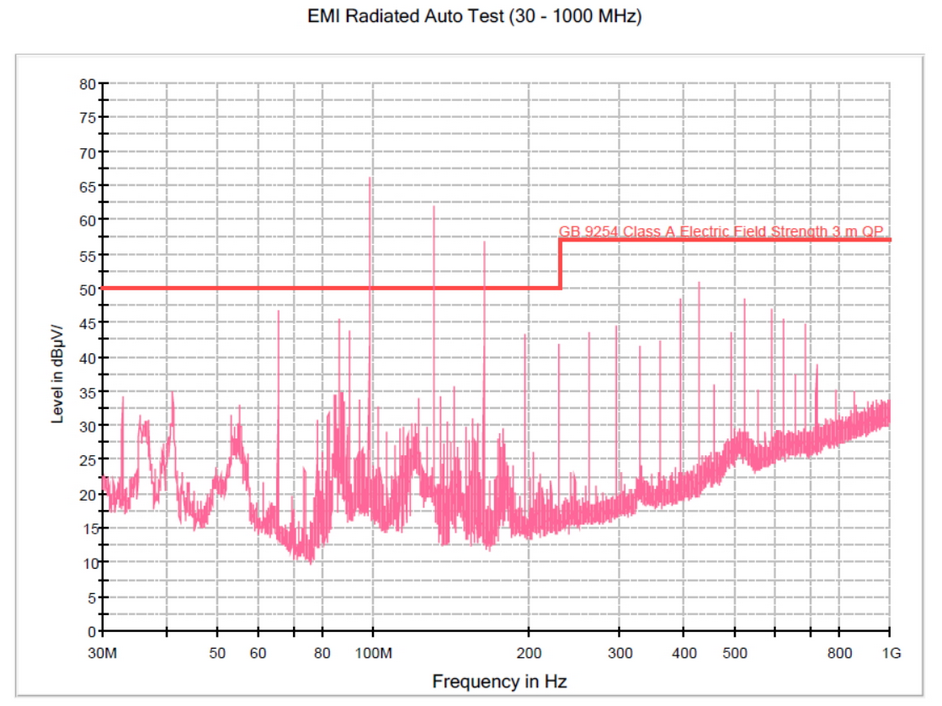
1.Find out the highest amplitude A' (65.9 dBuV, in below example) and its correspondent frequency A (98288000 Hz, in below example) on the spectrum chart of the EMC standard laboratory test report.
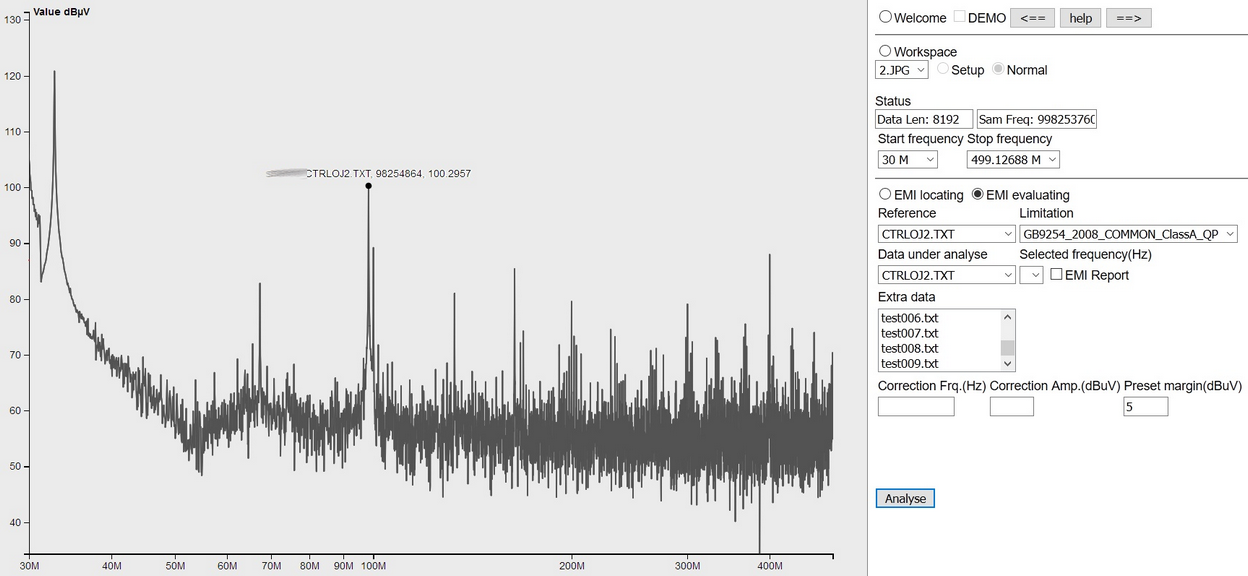
2. Select "EMI Evaluation", select "Reference Data" on both "Reference" and "Data under analyse" option list, click "Analyse" button to get the "Reference Data" spectrum. Move the mouse to find at point B (frequency 98254864 Hz, amplitude 100.2957 dBuV) a frequency B roughly equals the frequency A:
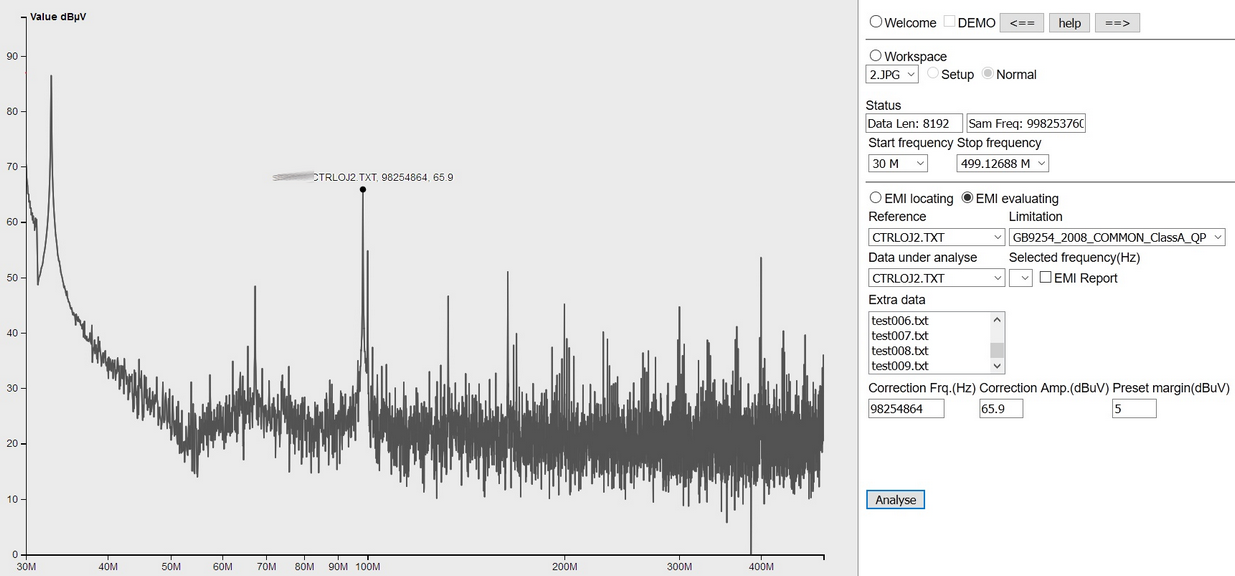
3. Input the frequency value of point B (98254864) to the "Correction Frq.(Hz)" field, and the amplitude value (65.9) of point A to the "Correction Amp.(dBuV)". Click on the "Analyse" button, EMCExplorer-SAAS recalculates the spectrum of the Reference Data, which has now the similar amplitude to the result of the EMC standard laboratory test report. Above steps complete the amplitude calibration of the "Reference Data" spectrum:
If you intend to make a "EMI evaluating" or generate a "EMI Report" with calibrated "Reference Data", you need to do calibration of "Reference Data" according to above methodology; If you only need to determine if the EMI level of the "Improved EUT" is decreased, you do not need to calibrate the "Reference Data".